Natural Innovation for a More Stable Mayonnaise
More information
Oxidation: The Invisible Threat to Mayonnaise Quality
Mayonnaise is one of the most widely consumed dressings worldwide. However, its high fat content, combined with its emulsified nature, makes it highly vulnerable to oxidation. This degradation process affects the flavor, aroma, color, and ultimately reduces the shelf-life of the product.
Oxidation is driven by multiple factors: unsaturated fats, exposure to oxygen, light, heat, and the presence of pro-oxidant metals like iron and copper — often introduced through raw materials or processing equipment. As a result, maintaining oxidative stability in mayonnaise is both a scientific and technological challenge for food manufacturers.
The Clean Label Movement and the EDTA Dilemma
Consumer demand for clean label, natural, and transparent ingredients is growing rapidly. One of the main targets in this shift is the removal of synthetic additives — including EDTA (ethylenediaminetetraacetic acid), a powerful metal chelator widely used to prevent oxidation in emulsions.
While EDTA is effective, it’s synthetic in origin and increasingly scrutinized by both consumers and regulatory bodies. However, completely replacing EDTA in formulations like mayonnaise is technically complex. Removing it can significantly compromise oxidative stability, leading to faster degradation and a shorter shelf life.
The solution? A smart, synergistic approach: working with chelators and natural antioxidants in tandem to maintain protection and move toward cleaner labels.
Chelator + Antioxidant: A Synergistic Strategy for Enhanced Protection
In oil-in-water emulsions like mayonnaise, oxidation occurs in both the lipid and aqueous phases. It’s a multi-step process where metal ions (like iron and copper) act as catalysts, accelerating the breakdown of unsaturated fats.
To effectively control oxidation, both the source and the chain reaction need to be addressed:
- Chelators like EDTA bind and neutralize metal ions, removing their catalytic effect.
- Natural antioxidants like tocopherols scavenge free radicals and stop oxidation from propagating.
This dual mechanism creates a synergistic effect — offering broader protection than either component alone. In practical terms:
- The chelators protects the water phase by stabilizing metal ions.
- The tocopherol-based antioxidant defends the oil phase by inhibiting radical formation and lipid breakdown.
Together, they:
- Delay the onset of oxidation
- Preserve taste, aroma, and color
- Extend product shelf life
- Enable partial or gradual replacement of synthetic additives
This synergy is especially valuable in transitional strategies toward clean label formulations, allowing manufacturers to maintain product performance while reducing synthetic input.
Btsa’s Solution: TOCOBIOL® – Natural Protection for Mayonnaise
At Btsa, we offer TOCOBIOL®, our 100% natural antioxidant range based on mixed tocopherols, specifically developed to protect fat-rich and emulsified systems like mayonnaise.
Key Benefits of Tocobiol®
- 100% natural origin
- Slows down oxidation in high-fat sauces and emulsions
- Acts in synergy with metal chelators
- Extends shelf-life naturally
- Supports clean label and natural formulation goals
Whether you are looking to reduce synthetic additives like EDTA or move toward fully natural protection, TOCOBIOL® provides an effective, science-backed solution that bridges performance with naturality.
Case Study TOCOBIOL® in Mayonnaise: Insights from RapidOxy Studies
To evaluate the antioxidant performance of TOCOBIOL® in emulsified systems, Btsa conducted a series of studies using the RapidOxy method — a validated protocol for assessing oxidative stability under accelerated conditions. These studies focused on mayonnaise formulations, with and without TOCOBIOL®.
Key observation from the trials include:
- Extended induction period: Samples with TOCOBIOL® exhibited a significantly longer induction time, indicating delayed lipid oxidation.
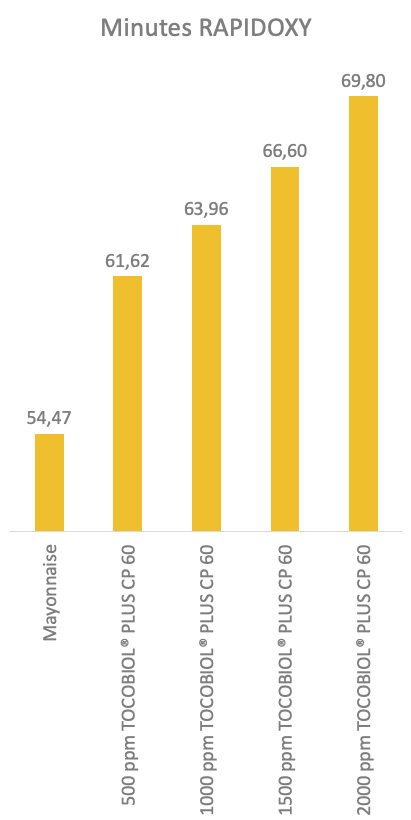
These results confirm that TOCOBIOL® provides effective antioxidant protection in high-fat emulsified systems and performs well. Its efficacy supports its use as part of a clean-label reformulation strategy in mayonnaise and similar products.
Conclusion
Controlling oxidation in mayonnaise remains a multifactorial challenge, especially in the context of clean label demands and the reduction of synthetic additives. The combined use of natural chelators and tocopherol-based antioxidants, such as TOCOBIOL®, offers a technically robust alternative that preserves oxidative stability while aligning with consumer and regulatory trends.
For detailed study data, formulation support, or application-specific recommendations, please contact Btsa’s technical team.
More information